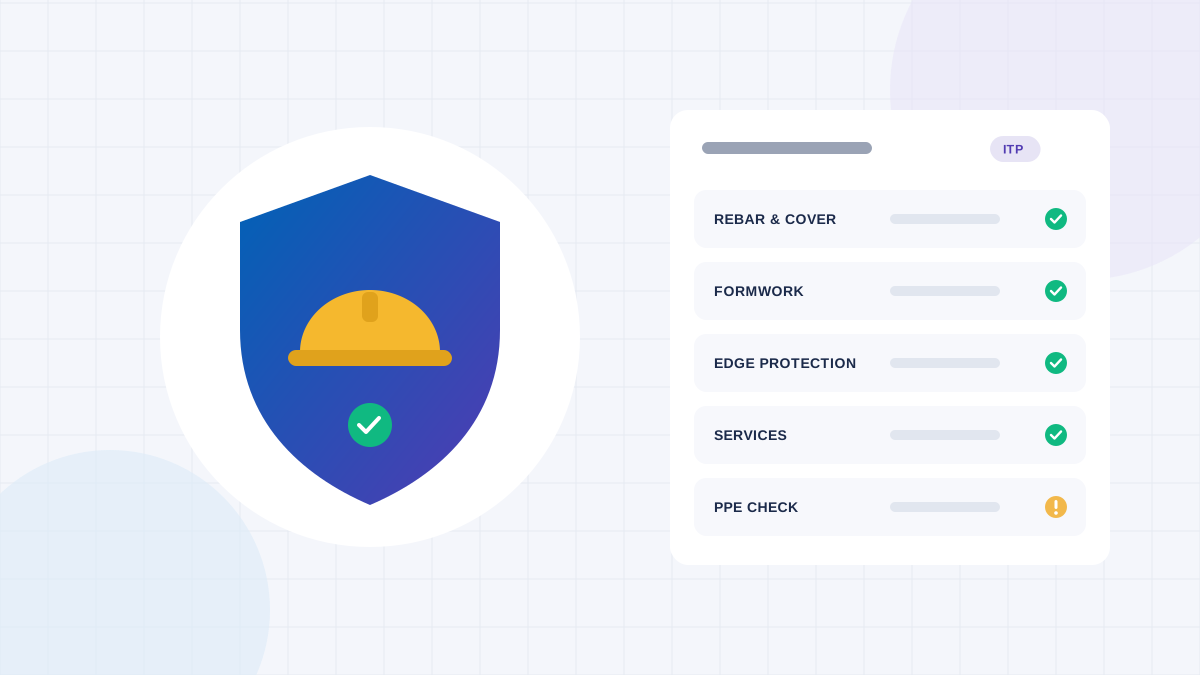
The short answer: Site safety and quality management is the system a construction project uses to prevent injuries and to make sure work meets the drawings and specification the first time. Safety rests on hazard planning, permits, PPE, training and incident reporting. Quality rests on an inspection and test plan, hold-point inspections, material testing and non-conformance tracking. Both depend on catching problems early and recording them.
Two things went wrong on a site last week. On Tuesday, a worker stepped back from a slab edge where the edge protection had been removed for a crane lift and not replaced. He was lucky; he caught a column. On Thursday, the plumbing inspection for L6 bathrooms was skipped because the waterproofing crew was waiting, and the floor was screeded over a joint that later leaked.
Both were ordinary pressures on an ordinary day. Both were preventable with a system that made the right check happen before the work moved on. This guide sets out that system for safety and quality together, because on site they fail for the same reasons: rushed handovers, unclear responsibility and checks that happen too late.
Why safety and quality belong together
- Same root causes: time pressure, missing information, unclear handovers between trades and untrained crews drive both accidents and defects.
- Same tools: planning, checklists, inspections before work proceeds, and recording what was found.
- Same people: the site engineer and supervisors who check formwork for quality are the ones who should check it for collapse risk.
- Same cost: an incident stops work and a defect means rework; both hit schedule, cost and reputation.
The biggest safety hazards on construction sites
Falls are the leading cause of construction deaths in many countries. In the United States, NIOSH reports that 423 of 1,056 construction fatalities in 2022 were falls, about a third of all deaths in the industry. Other major hazards are well known:
| Hazard | Where it happens | Key controls |
|---|---|---|
| Falls from height | Slab edges, openings, scaffolds, ladders, roofs | Edge protection, covered openings, inspected scaffolds, harnesses with anchor points, permits for work at height |
| Struck by objects | Under crane lifts, near stacked material, falling tools | Exclusion zones, toe boards, debris nets, banksman, helmets |
| Caught in / between | Excavations, machinery, collapsing formwork | Shoring and battering, machine guards, formwork design and checks |
| Electrocution | Temporary power, overhead lines, wet areas | Distribution boards with protective devices, cable management, isolation and lockout |
| Formwork and structural collapse | Slabs during pour, early deshuttering | Designed props, pre-pour inspection, controlled stripping times |
| Heat stress | Outdoor work in hot climates | Water, shade, rest breaks, schedule changes (e.g. the UAE summer midday break) |
| Fire | Hot work, stores, temporary wiring | Hot work permits, extinguishers, housekeeping, fire watch |
The site safety system: 8 building blocks
- Safety plan. A project-specific health, safety and environment (HSE) plan listing hazards, controls, responsibilities and emergency procedures.
- Risk assessment and method statements. For each high-risk activity, how the work will be done safely, reviewed before it starts.
- Induction. Every worker, including subcontractors' crews, is inducted before their first shift, in a language they understand.
- Permits to work. Written permission for high-risk tasks such as work at height, hot work, excavation, confined spaces and electrical isolation.
- PPE. Helmet, safety shoes, high-visibility vest and task-specific equipment such as harnesses, gloves, goggles and ear protection, issued and worn.
- Daily toolbox talks. A short briefing before work on the day's specific risks.
- Inspections. Daily walk-rounds plus scheduled checks of scaffolds, lifting gear, electrical systems and excavations.
- Incident and near-miss reporting. Every event is recorded, investigated for root cause and closed with an action.
Safety regulations to know
Requirements vary by country, and your contract may set higher standards. Examples for Brikito's core markets:
- India: construction safety is now governed by the Occupational Safety, Health and Working Conditions Code, which took effect with the other labour codes on 21 November 2025 and covers what the Building and Other Construction Workers Act used to. The National Building Code, Part 7, covers constructional practices and safety. State rules apply on top.
- UAE: outdoor work under direct sun is banned between 12:30 pm and 3 pm from 15 June to 15 September. Emirate-level authorities set further site safety requirements.
- Singapore: the Workplace Safety and Health Act and its regulations set duties for occupiers, employers and contractors.
Take local advice for your project's obligations. Our labour management guide covers the labour code changes in more detail.
The quality management system on site
Quality on site is about one thing: checking work at the moment it can still be corrected cheaply. Once concrete is poured or a wall is plastered, problems are expensive to find and fix.
Quality assurance vs quality control
| Quality assurance (QA) | Quality control (QC) | |
|---|---|---|
| Focus | The process that prevents defects | Checking the product for defects |
| Examples | Method statements, ITPs, approved materials, trained crews | Inspections, measurements, cube tests, snag lists |
| When | Before and during work | During and after each stage |
The inspection and test plan (ITP)
An ITP lists, for each activity, what is checked, against what standard, by whom, and whether it is a hold point (work cannot continue until signed off) or a witness point (the inspector may attend). Typical hold points on a building project:
- Setting out and levels before excavation and before each floor.
- Foundation bed before PCC.
- Reinforcement, cover blocks, formwork and embedded services before every pour.
- Waterproofing before protection screed and before flooding tests are signed off.
- Concealed plumbing and electrical conduits before plaster or screed.
- Brickwork or blockwork alignment before plaster.
Material approval and testing
Approve materials before they are ordered, check them when they arrive, and test them as the specification requires. For concrete, sampling and cube testing frequency follows the project specification and the applicable code; our site documentation guide includes the IS 456 sampling table.
The most common quality defects and how to prevent them
| Defect | Usual causes | Prevention |
|---|---|---|
| Honeycombing in concrete | Poor compaction, congested steel, leaking formwork, mix too stiff | Vibration plan, tight formwork, correct mix, pre-pour check |
| Cracks in concrete and plaster | Inadequate curing, shrinkage, early loading, poor joints | Curing plan and record, controlled deshuttering, mesh at joints |
| Inadequate cover to reinforcement | Missing or wrong cover blocks | Cover check at the pre-pour inspection |
| Leaks and dampness | Waterproofing failures at joints, pipe penetrations and terraces | Hold point before covering, flood test, detailed method statement |
| Hollow or uneven tiles | Poor bedding, wrong adhesive, uneven base | Base level check, approved method and materials |
| Wrong position of services | Old drawings, poor coordination between trades | Current drawings on site, services inspection before plaster |
Many of these trace back to coordination rather than workmanship. See rework isn't always a labour problem.
Non-conformance reports and snag lists
When work does not meet the specification, record it on a non-conformance report (NCR): what was found, where, the cause, the agreed fix (repair, replace or accept with approval), who does it, and when it is closed. NCRs left open are the ones that become handover defects.
Near completion, a snag list records every remaining defect by location, with owner and target date. The earlier snagging starts, floor by floor, the less it delays handover.
Safety and quality KPIs
- Lost time injury frequency rate (LTIFR): lost time injuries per million hours worked (or another agreed base).
- Near misses reported per month, and the share closed with an action.
- Safety inspection findings open vs closed.
- First-time inspection pass rate at hold points.
- Open NCRs and their average age.
- Cube test results below target strength.
- Rework hours or cost attributed to quality failures.
A daily safety and quality routine
- Before work: toolbox talk on today's risks; permits checked for high-risk tasks.
- First walk-round: edge protection, openings, scaffolds, housekeeping, PPE.
- Before each hold point: inspection request, check against the ITP, sign-off with photos.
- During the day: issues reported from the work front straight away, not saved for the evening.
- End of day: incidents, near misses, inspections and defects in the daily progress report.
- Weekly: review open findings, NCRs and trends with contractors.
Site safety and quality checklist
- Is there a project HSE plan and an ITP, both shared with every contractor?
- Has every worker been inducted before their first shift?
- Are permits in place for every high-risk task today?
- Are all slab edges and openings protected right now?
- Is every hold point inspected and signed before work is covered?
- Are cube results traceable to pours, and failures followed up?
- Are near misses reported and closed with actions?
- Are open NCRs reviewed weekly?
Where software fits
Most safety and quality failures are known to someone on site before they become incidents or defects. The problem is that the observation stays in a conversation, a photo on a phone or a notebook, and never reaches the person who can act.
In Brikito, construction management software with Brik AI, safety and quality issues reported in site chat are tagged as tickets and flagged on the project dashboard, so the PM sees them the same day. Where site CCTV is connected, BrikVision watches for missing helmets and vests and raises PPE alerts from the cameras. Inspections, tests and photos stay linked to the project record, ready for the daily report and for handover.
Frequently asked questions
What is the main cause of accidents on construction sites?
Falls from height are the leading cause of construction deaths in many countries. In the US, falls accounted for 423 of 1,056 construction fatalities in 2022, according to NIOSH. Struck-by incidents, caught-in or between incidents, and electrocution are the other major causes.
What PPE is required on a construction site?
The basic set is a safety helmet, safety shoes and a high-visibility vest. Task-specific PPE includes full-body harnesses for work at height, gloves, eye and face protection, hearing protection and respiratory protection, depending on the risk assessment.
What is the difference between QA and QC in construction?
Quality assurance is the planned system that prevents defects, such as method statements, inspection and test plans and approved materials. Quality control is the checking of completed work, such as inspections, measurements and tests.
What is an inspection and test plan (ITP)?
An ITP lists each activity's inspections and tests, the acceptance criteria, who checks, and whether each check is a hold point that stops work until approved or a witness point the inspector may attend.
What is an NCR in construction?
A non-conformance report records work or material that does not meet the specification, including the location, cause, agreed corrective action, responsible person and closure date.
What is a toolbox talk?
A toolbox talk is a short safety briefing, usually 5 to 15 minutes, held at the start of a shift to discuss the specific hazards and controls for that day's work.
Check before the work moves on
Most accidents and defects happen at a handover: from one trade to the next, from one stage to the next, or from one person's observation to nobody's action. Plan the hazards, inspect at hold points, report near misses and defects the moment they are seen, and close every finding. Safety and quality then stop being a separate department and become how the site works.