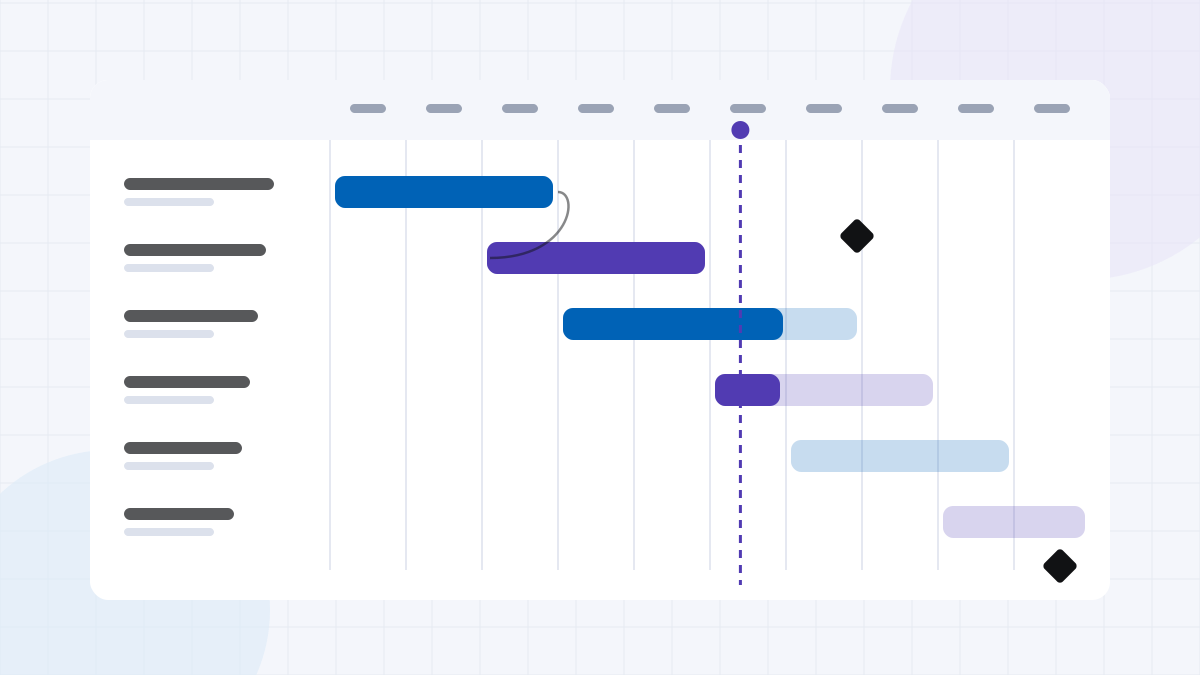
The short answer: Construction scheduling is planning what work happens when, in what order and with what resources, so a project finishes on time. Delay management is tracking actual progress against that plan every day, recording what caused each slip, and acting on blockers early. The schedule only helps if the site updates it honestly.
Almost every construction project starts with a schedule. Far fewer are still following it three months later. The bar chart on the office wall shows the slab cycle, the masonry, the finishes. Meanwhile the site has moved on, the plan has not, and the only person who knows how far behind the project really is happens to be the site engineer.
This guide covers how construction scheduling works at each level, from the master programme to tomorrow's plan, how the critical path and float decide which delays matter, how to track planned versus actual progress, and how to record and manage delays so they can be recovered rather than argued about later.
What is construction scheduling?
Construction scheduling is the process of breaking a project into activities, estimating how long each will take, defining the order and dependencies between them, assigning resources, and setting dates, so the team knows what must happen when for the project to finish on time.
Delay management is the other half: monitoring progress against the schedule, identifying slippage early, understanding its cause, and deciding how to recover. A schedule without delay management is a forecast that nobody checks.
Why scheduling matters for developers and contractors
- Time is money on both sides. Delays add site overheads, equipment hire, finance costs and escalation for the contractor, and can push back handover and buyer payments for the developer.
- Handover dates are often commitments. In many markets, completion dates are stated in sale agreements and regulatory filings, so slippage has consequences beyond the site.
- Most delay hides in waiting. Crews waiting for drawings, materials, approvals or the previous trade lose time that never appears as a single event. We explore this in where a construction project actually loses time.
- Delay disputes are won with records. If you cannot show when a hindrance started, who it was waiting on and what it affected, it is difficult to claim or defend an extension of time.
The four levels of a construction schedule
| Level | Horizon | Who uses it | Purpose |
|---|---|---|---|
| Master programme | Whole project | Developer, PMC, senior management | Milestones, critical path, overall duration |
| Look-ahead schedule | Next 3–6 weeks | Project manager, site engineers | Detailed activities, readiness and constraints |
| Weekly work plan | Next week | Site engineers, foremen, contractors | Commitments each crew will deliver |
| Daily plan | Tomorrow | Supervisors and crews | Who works where, with what |
Most scheduling failures happen between the master programme and the daily plan. The master programme says "Level 8 slab, week 23". Nobody translates that into the drawings, materials, crews and inspections needed, until the week arrives and something is missing.
Critical path and float: which delays actually matter
The critical path method (CPM) links activities by their dependencies and finds the longest chain through the project. That chain is the critical path, and it sets the shortest possible project duration.
- Critical activities have zero float. Any delay to them delays the project finish, unless the logic or resources change.
- Float (or slack) is how long a non-critical activity can slip without delaying the finish.
- The critical path moves. As activities slip and float is used up, activities that were not critical can become critical.
In a building project the structural frame is usually on the critical path, because each floor depends on the one below. That is why the floor cycle deserves so much attention. Its duration includes fixed technical periods, such as the formwork and prop removal times in IS 456, which the schedule must respect. Our guide to the building construction process explains the cycle.
Building realistic durations
- Base durations on quantities and productivity, not on what the deadline requires: quantity ÷ (crew output per day × number of crews).
- Respect fixed technical durations: curing, formwork removal, testing and approval lead times.
- Include procurement lead times for long-lead items like lifts, transformers, facade systems and imported finishes.
- Allow for local working conditions: monsoon or extreme heat, festival periods when labour availability drops, and restrictions on working hours.
- Get the people doing the work to check the durations. A foreman's estimate is often more realistic than a planner's.
Look-ahead planning and constraint removal
The look-ahead schedule is where most delays can be prevented. Each week, take the next three to six weeks of work and check every activity for constraints:
- Is the approved, current drawing available on site? See drawing revision control.
- Are materials ordered, with delivery confirmed before the start date? See construction material management.
- Is the crew available, and is the equipment booked?
- Is the preceding work complete, and has the area been handed over?
- Are inspections and approvals booked?
Activities with unresolved constraints should not go into next week's plan. Instead, each constraint gets an owner and a date to clear it. This idea comes from lean construction and the Last Planner System, which focuses on making only commitments that can actually be kept.
Tracking progress: planned versus actual
Progress tracking turns the schedule into a management tool. Three simple measures go a long way:
- Planned versus actual percentage complete for key activities and for the project. For example, if the plan for today is 68% and the site is at 62%, the project is behind, and the gap should be explained.
- Days behind or ahead on critical activities and milestones.
- Percent plan complete (PPC): the number of tasks completed as planned in a week, divided by the number of tasks planned, as a percentage. If 18 of 24 planned tasks were completed, PPC is 75%. Tracking PPC weekly, with the reason each missed task failed, shows whether planning is getting more reliable.
All of this depends on accurate daily data. The daily progress report is where planned versus actual should first appear.
Types of construction delay
Contracts treat delays differently depending on their cause. The exact terms depend on the contract, but the common categories are:
| Type | Typical meaning | Example |
|---|---|---|
| Excusable, compensable | Caused by the employer or their team; time and often cost may be due | Late drawings or late site access |
| Excusable, non-compensable | Caused by neither party; time may be due but not cost | Exceptional weather, if the contract allows |
| Non-excusable | Caused by the contractor; no extension, possible damages | Insufficient labour or late material ordering |
| Concurrent | Two or more delays overlapping, with different causes | Late drawings while the contractor was also under-manned |
The treatment of each type, and especially concurrent delay, depends on the contract and the law that governs it. Take advice on specific claims; the practical point for the site is that every delay needs a clear record of its cause and timing.
Recording delays and recovering time
A hindrance register is the simplest delay management tool. For each hindrance, record:
- The affected activity and location.
- The cause, and who is responsible for resolving it.
- When it started and when it ended.
- Its effect: work stopped, slowed, or resequenced.
- Supporting evidence: messages, photos, drawing revisions, letters.
When the project is behind, the usual recovery options are:
- Resequencing: changing the order of work so crews are not idle.
- Crashing: adding resources, such as extra crews or shifts, to critical activities.
- Fast-tracking: overlapping activities that were planned in sequence, where it is safe and technically allowed.
- Removing recurring constraints: fixing the cause, such as slow drawing approvals or late material indents, rather than just pushing harder.
Scheduling methods compared
| Method | Best for | Limitations |
|---|---|---|
| Bar (Gantt) chart | Communicating the plan simply to everyone | Shows dates, but dependencies and float are not always visible |
| Critical path method (CPM) | Finding which activities control the finish date | Only as good as the logic and durations entered |
| Line of balance | Repetitive work, such as typical floors or units | Less familiar to many site teams |
| Look-ahead and weekly work plans | Making near-term work reliable and removing constraints | Needs a weekly routine and honest reporting |
Most projects use a combination: a CPM master programme presented as a bar chart for management, and look-ahead and weekly plans for the site. The tools matter less than keeping the levels connected.
Running the weekly planning meeting
The weekly planning meeting is where scheduling becomes a habit. Keep it short and focused on the next few weeks, not on the past.
- Last week: which planned tasks were completed, PPC, and the reason for each miss.
- Critical path: any slippage on critical activities and its effect on milestones.
- Look-ahead: constraints for the next three to six weeks, each with an owner and a date.
- Next week's plan: commitments from each crew and contractor, only for work that is ready.
- Open hindrances: anything waiting on the developer, consultants or authorities, escalated by name.
Record the outcome in the same place every week. Next week's meeting starts by checking whether this week's commitments were kept.
Schedule KPIs worth tracking
- Planned versus actual percentage complete, for the project and for each major package.
- Days ahead or behind on each milestone and on the forecast finish.
- PPC each week, with the trend over the last six to eight weeks.
- Top reasons for missed tasks, counted by category.
- Open constraints in the look-ahead, and how many were cleared on time.
- Floor cycle time on the structure, compared with the planned cycle.
These measures connect directly to cost: every week added to the forecast finish adds time-related overheads. Our guide to construction cost control explains how to carry that into the forecast at completion.
The biggest construction scheduling problems on site
- A master programme that is never translated into look-ahead and weekly plans.
- Progress updated monthly, so slippage is visible weeks after it started.
- Percentage complete reported by feel, not by measured quantities.
- Hindrances discussed in calls and chats but never recorded with dates and owners.
- Durations set to match the deadline rather than real productivity.
- The critical path not reviewed, so the team works hard on activities that do not move the finish date.
How to improve construction scheduling step by step
- Build the master programme from real quantities and productivity, including fixed technical durations and procurement lead times.
- Identify the critical path and review it every time the schedule is updated.
- Run a weekly look-ahead covering three to six weeks, and screen every activity for constraints.
- Commit to a weekly work plan containing only activities whose constraints are cleared.
- Record progress daily by quantity and location, and compare it with the plan.
- Keep a hindrance register with cause, owner, start and end times, and evidence.
- Track PPC and reasons for missed tasks every week, and fix the most common causes.
- Update the forecast finish and act on slippage on critical activities immediately.
Construction scheduling checklist
- Is the master programme based on quantities and realistic productivity?
- Is the critical path identified and reviewed with each update?
- Is there a look-ahead schedule for the next three to six weeks?
- Are drawings, materials, crews, equipment and approvals checked before work is planned?
- Is planned versus actual progress visible every day?
- Is every hindrance recorded with cause, owner and dates?
- Is PPC tracked weekly with reasons for misses?
- Is the forecast finish updated and shared with the developer?
Where software fits
Scheduling tools are good at building the master programme. The harder part is keeping it connected to what actually happens on site each day. If progress, blockers and resources are reported through calls and chats, the schedule falls out of date within weeks, and the only real view of progress is in people's heads.
Software helps when the site's daily updates feed the plan directly. In Brikito, construction management software with Brik AI, the dashboard shows progress against plan and days behind, updated as the site team posts its updates in the chat. A gap such as 62% actual against 68% planned surfaces on the day it appears, not at the month-end review. On the Professional plan, teams can upload the schedule, record weekly plans by voice, and track day-by-day plan versus actual, delay and lag per activity, PPC and a forecast finish.
Frequently asked questions
What is the critical path in construction?
The critical path is the longest chain of dependent activities from start to finish. It sets the shortest possible project duration, so any delay to a critical activity delays the whole project unless the plan or resources change.
What is float in a construction schedule?
Float, or slack, is the amount of time a non-critical activity can be delayed without delaying the project finish. Once float is used up, the activity becomes critical.
What is a look-ahead schedule?
A look-ahead schedule details the next three to six weeks of work, so the team can check drawings, materials, crews, equipment and approvals in advance and remove constraints before the work is due to start.
What is PPC in construction?
Percent plan complete (PPC) is the number of tasks completed as planned in a week divided by the number planned, expressed as a percentage. It measures how reliable weekly planning is.
How do you recover a delayed construction project?
Common options are resequencing work, adding resources to critical activities, overlapping activities where it is safe to do so, and fixing the recurring causes of delay. The right mix depends on the critical path and the cause of the delay.
How should construction delays be documented?
Keep a hindrance register recording the affected activity, the cause, who must resolve it, when it started and ended, its effect, and supporting evidence such as messages, photos and drawing revisions.
A schedule is only as good as its last update
Construction scheduling is not a one-time document. It is a weekly routine: look ahead, clear constraints, commit to what can be done, measure what was done, and record why the rest was not.
Projects that keep that routine see delays when they are small and fixable. Projects that do not find out at the monthly review, when the only options left are expensive ones.