
The short answer: A material indent in construction is a formal request raised by the site team for materials needed for upcoming work. It states the item, specification, quantity, the date it is needed and the activity it is for. The indent goes to the project manager or stores for approval, and then becomes a stock issue or a purchase order. It is the first record in the chain from indent to purchase order, goods receipt and consumption.
Every bag of cement, tonne of steel and load of sand on a construction site starts as a request from someone who needs it. On a well-run site, that request is an indent: written, numbered and traceable. On a badly run site, it is a phone call or a line in a group chat that nobody acts on until the pour is stopped.
This short guide explains what a material indent is, what it should contain, who raises and approves it, and how it connects to the rest of material management.
What is a material indent?
A material indent (also called a material requisition or material request) is a document in which the site asks for materials for a specific activity. In Indian construction the word "indent" is used almost everywhere. In the Gulf and Singapore you will more often hear "material requisition" or "MR". They mean the same thing.
An indent is not an order. It is an internal request. Someone with authority checks it against the BOQ, the budget and the stock in the store, then decides whether to issue from stock, transfer from another site or raise a purchase order with a supplier.
What a material indent should include
| Field | Example | Why it matters |
|---|---|---|
| Indent number and date | IND-B-0142, 16 Nov 2026 | Makes the request traceable and avoids duplicates |
| Project, block and location | Tower B, 7th floor slab | Links the material to where it will be used |
| Item and specification | OPC 53 grade cement | Prevents the wrong grade or size being bought |
| Quantity and unit | 50 bags | Can be checked against the BOQ and drawings |
| Required-by date | 18 Nov 2026, 7 am | Gives purchase a deadline tied to the programme |
| Activity or BOQ item | RCC slab, BOQ item 5.3 | Lets the office compare indents with budgeted quantities |
| Raised by and approved by | Site engineer, project manager | Shows who asked and who authorised it |
| Status | Approved, PO raised, delivered | Everyone can see where the request is |
A material indent example from site
The site engineer on Tower B plans the 7th floor slab pour for Wednesday. He checks the BOQ and the bar bending schedule and works out what is needed beyond what is already in the store:
- OPC 53 cement: 50 bags
- 12 mm TMT bars: 1.2 tonnes
- Binding wire: 25 kg
- Cover blocks, 25 mm: 400 nos
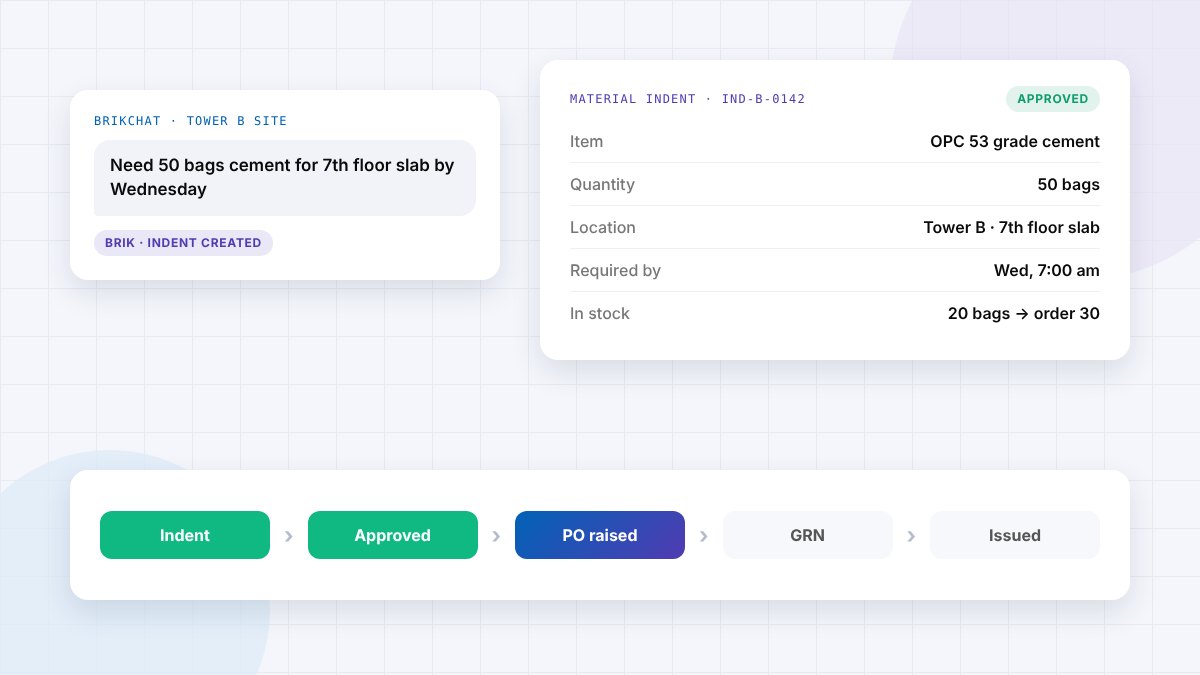
He raises one indent on Monday morning with a required-by date of Wednesday 7 am. The project manager approves it within the hour. Stores confirm that 20 bags of cement are already in stock, so 30 bags, the steel and the cover blocks go to purchase. Purchase raises the order the same day, the materials arrive on Tuesday and the goods receipt note (GRN) closes the indent.
The same request sent as "need cement and steel for slab" in a group chat would have no quantity, no date and no owner. That is how slabs get delayed.
Where the indent sits in material management
- Indent: site requests materials for an activity.
- Approval: the PM or stores check the quantity against BOQ, budget and stock.
- Purchase order: purchase orders the balance from an approved supplier.
- Goods receipt note: stores check quantity and quality on delivery and record the GRN.
- Issue and consumption: materials are issued to the activity and consumption is reconciled against theoretical quantities.
Our construction material management guide covers each of these steps in detail.
Common indent mistakes
- Raising indents too late. If the lead time for steel is three days and the indent goes in the day before, the pour slips. Plan indents from the look-ahead schedule, not from today's work.
- Vague specifications. "Cement" or "rods" leads to the wrong grade or diameter.
- Indenting from memory. Quantities should come from the BOQ, drawings and BBS, not a rough guess.
- No status. When the site can't see whether an indent is approved or ordered, they call, chase and raise duplicates.
- Emergency buying. Local purchases to cover a missed indent usually cost more and skip quality checks.
Related terms
- Purchase order (PO): the formal order to a supplier, raised from an approved indent.
- Goods receipt note (GRN): the record that materials arrived in the right quantity and condition.
- Material issue slip: the record of materials issued from the store to an activity or contractor.
- Bill of quantities (BOQ): the measured quantities that indents should be checked against. See how to prepare a BOQ.
- Material reconciliation: comparing materials issued with the theoretical quantity for the work done.
How indents work in Brikito
In Brikito, the site engineer can type or say "need 50 bags cement for 7th floor slab by Wednesday" in BrikChat, in English or a local language. Brik AI turns the message into a structured indent with item, quantity, location and date, and routes it to the project manager. Brik checks the stock record and can draft the purchase order, but a person approves every indent and every PO. The site sees the status as it changes, and the GRN closes the loop.
See BrikChat for how site messages become indents, and BrikDocs for the GRN and stock statement.
Frequently asked questions
What is the meaning of indent in construction?
An indent is a written request from the site for materials needed for upcoming work. It lists the item, specification, quantity, required date and activity, and is approved before materials are issued or purchased.
What is the difference between an indent and a purchase order?
An indent is an internal request from the site. A purchase order is the formal order sent to a supplier after the indent is approved and checked against stock and budget.
Who raises a material indent on a construction site?
Usually the site engineer or supervisor responsible for the activity. The project manager or store in-charge approves it, and the purchase team orders anything not available in stock.
Is a material indent the same as a material requisition?
Yes. "Indent" is the common term in India. "Material requisition" or "MR" is more common in the UAE, Singapore and international projects.
How early should a material indent be raised?
Early enough to cover approval and the supplier's lead time, plus a buffer. Plan indents from the two- to three-week look-ahead schedule rather than from the day's work.
One request, one record
A material indent is a simple document, but it decides whether materials arrive before the crew needs them. Make every indent specific, dated and visible to everyone who touches it, and most "we're waiting for material" delays disappear.