
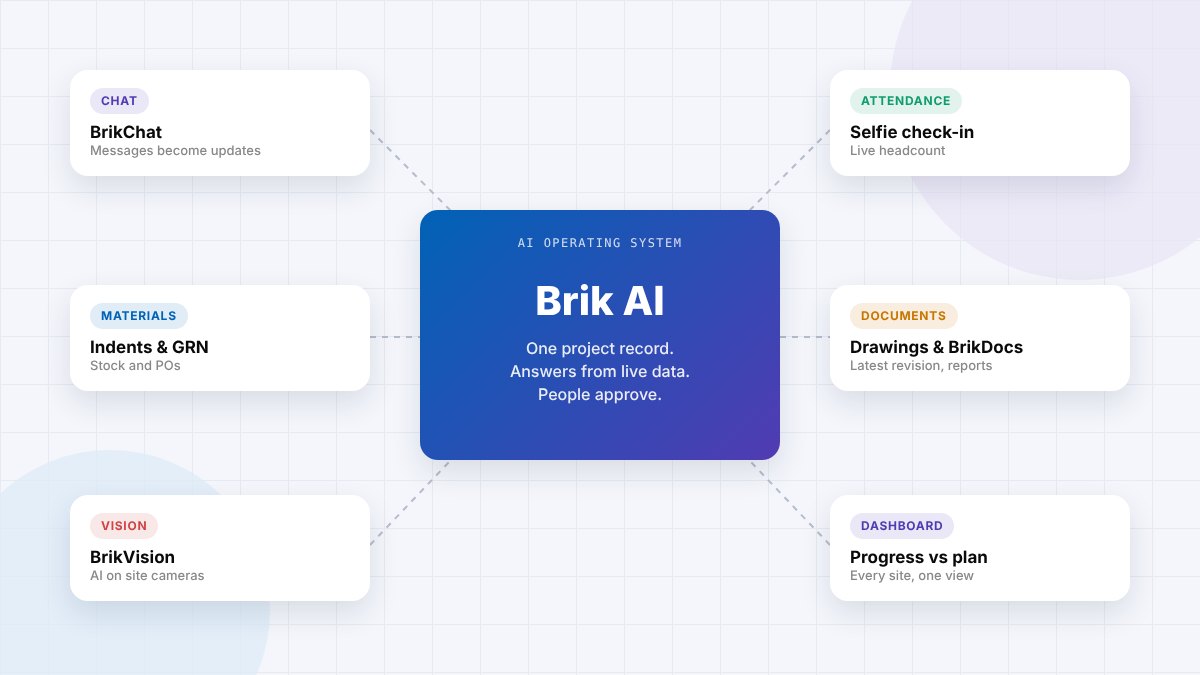
The short answer: An AI operating system for construction is one platform where a project's site chat, attendance, materials, drawings, documents and camera feeds live together. An AI layer reads that live data, answers questions, drafts reports and routes work to the right person. People still approve every decision. Brikito describes itself as the AI operating system for construction sites.
Most construction companies don't have one system. They have six: a WhatsApp group, a paper register, a drawings folder, email, spreadsheets and phone calls. Each holds part of the truth, and the project manager's job becomes stitching them together.
The idea behind an "AI operating system" is to replace that patchwork with one place where the project's information lives, and to put AI to work on top of it. This short guide explains what the term means, what one includes and how it differs from ordinary software.
What is an AI operating system for construction?
A computer's operating system runs everything else: files, apps and permissions. An AI operating system for construction does the same for a project. It is the layer where all project information is captured and connected, and where an AI assistant can work across it. The term is a description, not a formal standard. What matters is that it does three things:
- Captures site information where it happens: messages, voice notes, photos, check-ins, deliveries and camera feeds.
- Connects it into one project record, so an indent links to its delivery, a delay to its cause and a drawing to its revision.
- Acts on it with AI: answering questions, drafting reports and replies, and flagging problems, with people approving what happens next.
What an AI operating system includes
| Layer | What it does | In Brikito |
|---|---|---|
| Communication | Site chat where every message becomes structured data | BrikChat |
| Workflows | Indents, approvals, attendance, tickets and progress | Indents, Attendance, Dashboard |
| Documents | Drawings with revisions, BOQs, agreements and reports | Documents, BrikDocs |
| Vision | AI on site cameras for headcount, deliveries and PPE | BrikVision |
| AI assistant | Answers in plain language from live data, scoped by role | Brik AI |
| Permissions | Who sees what: site, office, contractor, owner | Role-based access |
An example from site
At 9 am, a site engineer sends a voice note in Tamil: "Slab shuttering done on 8th floor, steel short by one tonne, need it by tomorrow." In a group chat, that message scrolls away. In an AI operating system, it is tagged as a progress update and a material request. Progress for the 8th floor slab is updated, an indent is drafted for the project manager and the shortage is linked to Thursday's pour. At 11 am, the developer asks, "Is Tower B on track for the slab this week?" and gets an answer built from those records, with the source messages attached.
No one filled in a form. The information was captured once and used everywhere.
How it differs from construction software and chatbots
- Point tools solve one job, such as attendance or drawings, and leave the PM to join them up.
- Traditional construction management software joins the data, but usually needs the site to fill in forms the office designed. See our construction management software buyer's guide.
- General AI chatbots can write and summarise, but don't know your project, so their answers aren't grounded in your data.
- An AI operating system captures data the way the site already works, then grounds the AI in it.
Who uses it and when
- Site engineers and supervisors: all day, by chatting, sending photos and checking in, as they do now.
- Project managers: to approve indents and see what is blocked, without chasing calls.
- Developers and owners: to ask how each project is doing and get an answer with evidence.
- Office teams: to get reports such as DPRs and stock statements without retyping site data.
Related terms
- Construction management software: software that manages project information and workflows.
- Common data environment (CDE): the single source of project information described in ISO 19650, mainly for design and documents.
- AI agent: AI that takes steps on a task, such as drafting a purchase order, for a person to approve.
- Computer vision: AI that reads images and video. See AI CCTV for construction sites.
- AI in construction: the wider field. See AI in construction.
Brikito: the AI operating system for construction sites
Brikito brings site chat, attendance, indents, drawings, documents and cameras into one project record, with Brik AI working across it in English and six Indian languages. Brik answers from live project data and is scoped by role, so a contractor sees their work and a developer sees every site. Brik drafts and flags, and a person approves. Learn more about Brik AI, or read how it compares in our guide to the best AI construction management software.
Frequently asked questions
What is an AI operating system for construction?
A single platform where all of a construction project's information is captured and connected, with an AI layer that answers questions, drafts reports and routes work from that live data, while people approve decisions.
Is an AI operating system the same as construction management software?
It is a kind of construction management software, built so that information is captured from how the site already works, such as chat, voice and photos, and so that AI can work across all of it.
Does an AI operating system replace the project manager?
No. It removes chasing, retyping and searching. The project manager still makes and approves decisions.
What is Brikito?
Brikito is an AI operating system for construction sites. It combines site chat, attendance, indents, drawings, documents and AI on site cameras, with Brik AI answering questions from live project data.
Can an AI operating system work with multilingual site teams?
It should. Brikito works in English, Hindi, Marathi, Tamil, Telugu, Kannada and Bengali, including voice notes.
One record, many answers
An AI operating system is not about adding another app. It is about having one place where the site's information lands, so that AI and people can work from the same facts.