
The short answer: The most common causes of delays in construction are late drawings and design changes, slow decisions and approvals, late payments, material shortages, labour shortages, unrealistic schedules, poor subcontractor coordination, permits, land and site access, unforeseen ground conditions, weather, equipment breakdowns, rework, slow site communication and disputes. Most start as small daily waits that can be caught early if the site records them the day they happen.
Delays are the most common problem in construction. In India alone, the central government's monitoring report for July 2026 tracked 1,775 ongoing infrastructure projects worth over ₹150 crore each. Their revised cost was about ₹3.4 lakh crore higher than originally estimated, according to Business Standard's report on the MoSPI data. Much of that overrun follows time overrun.
Big delays are rarely one event. They are dozens of small ones: a drawing that arrives two days late, a cement indent nobody picked up, a decision that waits for next week's meeting. Below are the 15 most common causes of delays in construction, why each matters and what to do about it.
1. Late or incomplete drawings
When construction drawings arrive after the site needs them, or arrive with missing details, work stops or proceeds on guesses. What to do: agree a drawing release schedule tied to the construction programme, and track open RFIs by age.
2. Design changes and variations
Changes after work starts cause rework, new approvals and resequencing. What to do: freeze design before each stage starts, and record every change with its time and cost impact before it is carried out.
3. Slow client decisions and approvals
Material samples, finishes and shop drawings waiting for approval stop the next activity. What to do: list every pending decision with a "needed by" date and an owner, and review the list weekly.
4. Late payments and cash-flow problems
When contractor bills are paid late, contractors slow down, suppliers stop deliveries and labour leaves. What to do: certify bills on measured quantities quickly, and plan cash flow against the schedule, not just the budget.
5. Material shortages and late deliveries
A slab pour can't happen without cement, steel and concrete on time. What to do: raise material indents from the look-ahead schedule with lead times built in, and make indent status visible to the site.
6. Labour shortages and low productivity
Festivals, harvest seasons and competing sites pull workers away, and productivity drops when crews wait for materials or instructions. What to do: track daily headcount against plan by trade, and fix the waits that idle crews. See our labour management guide.
7. Unrealistic schedules and poor planning
Programmes built to win a tender, not to build the project, are late before work starts. What to do: base durations on real productivity, identify the critical path and plan in two- to three-week look-aheads. Our construction scheduling guide covers how.
8. Poor subcontractor coordination
Trades waiting for each other's work fronts, or working in the same area at the same time, lose days every week. What to do: plan by trade and area, and sign off area handovers between trades. See subcontractor management.
9. Permits and statutory approvals
Building approvals, environmental clearances, fire NOCs and utility connections can each hold up a stage. What to do: map every approval to the stage that needs it and start applications early.
10. Land acquisition and site access
On infrastructure and large projects, land not yet handed over, encroachments or utility shifting can stop work on whole stretches. What to do: sequence work around the land that is actually available, and record access delays as they happen.
11. Unforeseen ground conditions
Rock, soft soil or high groundwater not shown in the soil investigation changes foundation design and methods. What to do: invest in a proper geotechnical investigation, and record the actual conditions with photos the day they are found.
12. Weather and monsoon
Heavy rain stops excavation, concreting and external work, and extreme heat limits working hours. What to do: plan weather-sensitive work outside the monsoon where possible, and log lost days daily so weather delays can be proven.
13. Equipment breakdowns
A tower crane or concrete pump breakdown can stop a whole floor cycle. What to do: follow preventive maintenance and keep backup arrangements for critical equipment.
14. Rework from errors and outdated information
Work built to an old drawing revision or a misunderstood instruction must be broken and rebuilt. What to do: control drawing revisions on site and confirm instructions in writing. See why rework isn't always a labour problem.
15. Slow site communication and disputes
When updates sit in phone calls and chat groups, problems reach the office days late. When nothing is recorded, delays turn into disputes that take longer to settle than the delay itself. What to do: capture site updates daily in one place, so every delay has a date, a cause and evidence.
Causes of construction delays: summary table
| # | Cause | Usually in whose control | Early warning sign |
|---|---|---|---|
| 1 | Late or incomplete drawings | Owner / consultant | RFIs open for more than a week |
| 2 | Design changes | Owner / consultant | Revisions after work has started |
| 3 | Slow decisions and approvals | Owner | Approvals pending past their "needed by" date |
| 4 | Late payments | Owner | Bills uncertified after the agreed period |
| 5 | Material shortages | Contractor / purchase | Indents raised inside the lead time |
| 6 | Labour shortages | Contractor | Headcount below plan for three days running |
| 7 | Unrealistic schedule | Contractor / owner | Planned progress missed in the first month |
| 8 | Subcontractor coordination | Contractor | Trades waiting for work fronts |
| 9 | Permits and approvals | Owner (usually) | Applications not filed before the stage |
| 10 | Land and site access | Owner | Areas not handed over on time |
| 11 | Unforeseen ground conditions | Shared (per contract) | Excavation differs from the soil report |
| 12 | Weather | Neutral | Forecast and logged rain days |
| 13 | Equipment breakdowns | Contractor | Missed maintenance, repeated stoppages |
| 14 | Rework | Contractor / consultant | Work done to superseded drawings |
| 15 | Communication and disputes | Everyone | Issues reaching the office days late |
Who carries the risk for each cause depends on the contract. The difference between excusable, compensable and non-excusable delays is explained in our scheduling and delay management guide.
How to track delays before they grow
- Record every hold-up the day it happens, with the cause, the activity, the location and a photo.
- Compare planned and actual progress weekly on the activities that drive the finish date.
- Track the waits: RFIs, approvals, indents and payments, each with an age.
- Review the top three causes every week and fix the cause, not just the symptom.
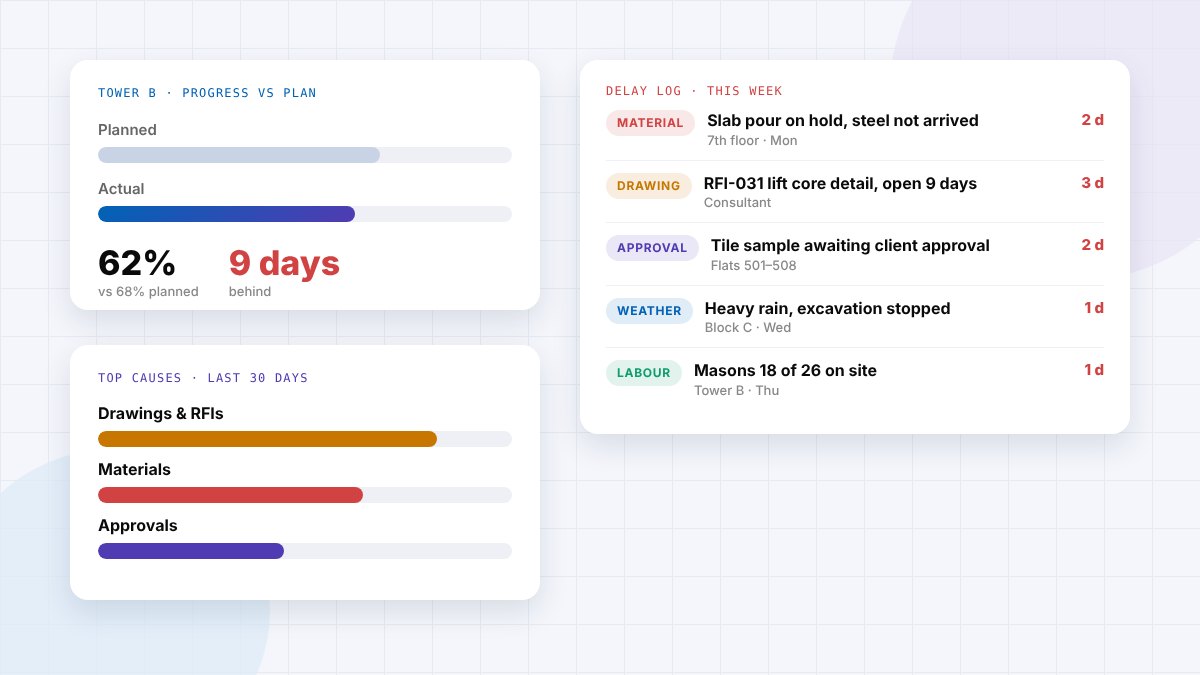
Brikito does this from the conversations the site is already having. BrikChat tags messages such as "slab pour on hold, steel not arrived" as delays and routes them to the project manager. The dashboard shows progress against plan and days behind as the site reports. Brik AI can answer "what is holding up Tower B this week?" from live project data. See how it works.
Frequently asked questions
What is the most common cause of delay in construction?
Studies in different countries rank causes differently, but late design information, slow owner decisions, payment delays, material shortages and poor planning consistently appear near the top.
What are the main types of construction delays?
Delays are usually classed as excusable or non-excusable, and excusable delays as compensable or non-compensable. Whether a delay entitles the contractor to more time or money depends on its cause and the contract.
How can construction delays be prevented?
Realistic scheduling, early design freeze, look-ahead planning, timely approvals and payments, and daily recording of site issues prevent most delays or catch them while they are still small.
How do you prove a construction delay?
With contemporaneous records: daily reports, dated photos, correspondence, RFIs and the updated programme showing the impact on the critical path.
Why are infrastructure projects in India delayed?
Commonly cited reasons include land acquisition, forest and environmental clearances, utility shifting, funding constraints, contractual issues and law and order problems in some regions.
Delays start small
Few projects are delayed by one big event. They are delayed by small waits that nobody records until they add up. Name the causes, track the waits and record each hold-up the day it happens, and most delays can be caught while there is still time to recover.