
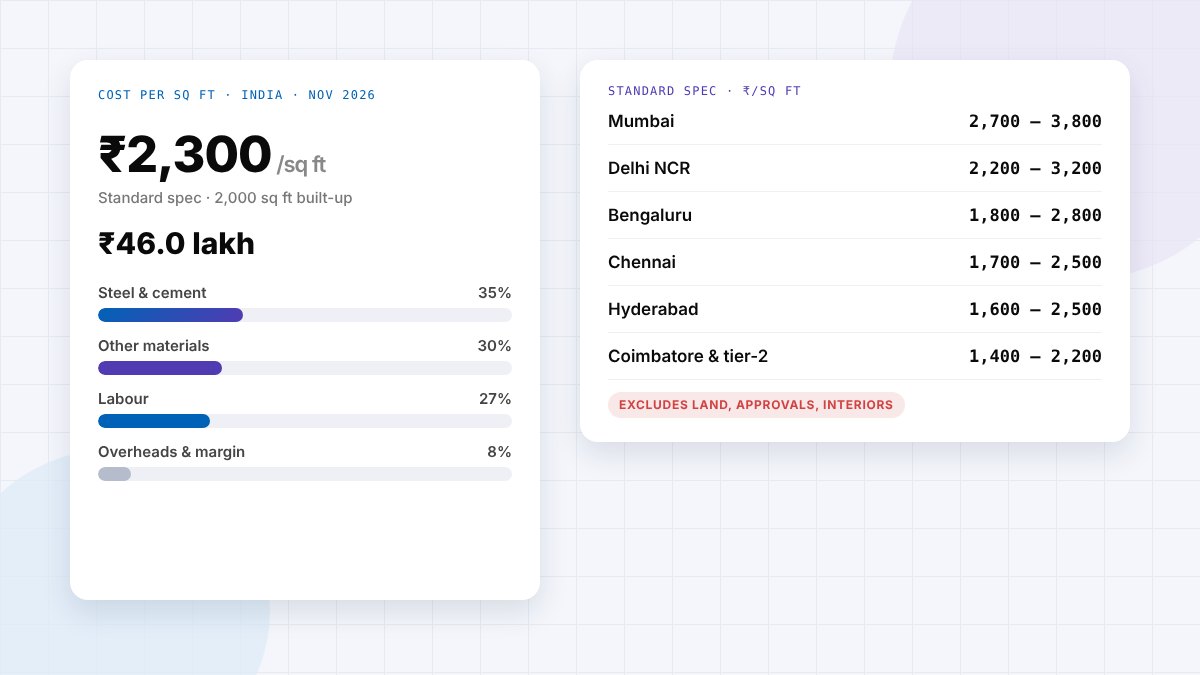
The short answer (as of November 2026): Building a standard RCC house in India typically costs about ₹2,000 to ₹2,800 per sq ft of built-up area. Basic specifications cost about ₹1,500 to ₹2,000 per sq ft, and premium builds start at about ₹3,000 per sq ft. Metro cities such as Mumbai and Bengaluru sit at the top of these ranges, and tier-2 cities such as Coimbatore at the lower end. Land, approvals and interiors are extra.
"What is the construction cost per sq ft?" is the first question every house owner and small developer asks, and the answers online range from ₹1,200 to ₹5,000. Both ends can be right. The rate depends on the city, the specification, the type of building and, most of all, what the quote actually includes.
This guide gives indicative 2026 ranges by quality and city, shows where the money goes, works through an example, and explains how to compare quotes so a low per sq ft rate doesn't become a high final bill.
Construction cost per sq ft in India by quality
| Specification | Indicative cost per sq ft (2026) | What it usually means |
|---|---|---|
| Basic | ₹1,500 – ₹2,000 | Standard brands of cement and steel, vitrified tiles, basic sanitary fittings, emulsion paint, standard doors and windows |
| Standard | ₹2,000 – ₹2,800 | Better tiles and fittings, UPVC or good aluminium windows, modular switches, branded plumbing and electricals |
| Premium | ₹3,000 and above | Granite or marble, premium fittings, teak or engineered doors, false ceilings, higher-end finishes |
These are construction-only ranges for RCC framed residential buildings, measured on built-up area. They are compiled from published 2026 guides including InfraLens, and published sources differ by 10 to 20%. Treat them as a starting point for a budget, not a quote.
Construction cost per sq ft by city
| City | Standard (₹/sq ft) | Premium (₹/sq ft) |
|---|---|---|
| Mumbai | 2,700 – 3,800 | 3,500 – 5,500+ |
| Delhi NCR | 2,200 – 3,200 | 3,000 – 4,500 |
| Bengaluru | 1,800 – 2,800 | 2,500 – 4,200 |
| Chennai | 1,700 – 2,500 | 2,600 – 4,000 |
| Hyderabad | 1,600 – 2,500 | 2,400 – 3,800 |
| Pune | 1,600 – 2,300 | 2,200 – 3,500 |
| Tier-2 cities (e.g. Coimbatore, Kochi, Indore) | 1,400 – 2,200 | 2,000 – 3,200 |
City ranges are mid-2026 market rates from SiteSetu's city-wise guide (updated October 2026), for G+2 to G+4 residential buildings. Rates within a city vary by locality, site access and contractor.
Where the money goes
For a typical standard-specification house, published 2026 breakdowns agree on roughly this split:
- Materials: about 60–70% of the construction cost.
- Labour: about 25–30%.
- Contractor overheads and margin: about 5–10%.
Steel and cement together usually make up 30–40% of the total, which is why their prices move the per sq ft rate so much. The all-India average cement price was about ₹356 per bag in September 2026, up ₹7 from August, according to a Centrum Broking report covered by Business Today. Finishes are the other big variable: tiles, doors, windows and fittings can swing the rate by ₹500 per sq ft or more.
Worked example: a 2,000 sq ft house
A G+1 house with 2,000 sq ft of built-up area, standard specification, at ₹2,300 per sq ft:
| Component | Share | Approx. amount |
|---|---|---|
| Steel and cement | 35% | ₹16.1 lakh |
| Other materials (sand, aggregate, blocks, finishes, plumbing, electrical) | 30% | ₹13.8 lakh |
| Labour | 27% | ₹12.4 lakh |
| Contractor overheads and margin | 8% | ₹3.7 lakh |
| Construction cost | 100% | ₹46.0 lakh |
The shares are illustrative. Add the items listed below to get the real project budget.
What a per sq ft rate usually doesn't include
- Land, registration and stamp duty
- Plan approval and permit fees, and the architect's and structural engineer's fees
- Soil investigation
- Compound wall, gate, sump, septic tank, borewell and landscaping
- Electricity, water and sewer connections
- Interiors: modular kitchen, wardrobes, false ceiling, lighting
- GST, if the quote is exclusive of it
Ask every contractor for this list in writing. Two quotes at the same rate can be lakhs apart once exclusions are counted.
Built-up, carpet or super built-up: which area?
Contractors normally quote on built-up area: the floor area including walls. Carpet area is the usable floor area inside the walls, and super built-up area adds a share of common areas in apartments. Also check how balconies, staircase headroom, sunshades and the terrace are counted, as some contractors charge them at full rate and others at half. A rate per sq ft means nothing until you know which square feet.
How to estimate and control your construction cost
- Fix the area and specification first. Agree the drawings and a written specification for every finish before asking for prices.
- Get a soil test and structural design. Foundation cost depends on ground conditions.
- Ask for a BOQ-based quote, not just a per sq ft rate. See how to prepare a BOQ.
- Compare quotes like for like: same area definition, specification and exclusions.
- Tie payments to stages, such as foundation, each slab, brickwork and finishing. Our stages of house construction guide lists the checks at each one.
- Track material and labour against the budget every week, not at the end.
Why projects go over the per sq ft budget
- Specification creep: upgrades decided on site, one at a time.
- Material price rises between quote and purchase, especially steel and cement.
- Wastage and theft that nobody measures.
- Delays: every extra month adds labour, supervision and rent. See 15 causes of construction delays.
- Exclusions that weren't budgeted.
Keeping cost per sq ft on track with Brikito
A per sq ft estimate only holds if the site records what is actually used. In Brikito, site teams log indents, deliveries, attendance and progress from their phones in English and six Indian languages, and the project manager sees material and labour against plan for each site. Project data is hosted in India. Our construction cost control guide explains how to set this up, and the market guide covers India alongside the UAE, Singapore and Sri Lanka.
Frequently asked questions
What is the construction cost per sq ft in India in 2026?
About ₹1,500 to ₹2,000 per sq ft for basic specification, ₹2,000 to ₹2,800 for standard and ₹3,000 or more for premium, for RCC residential buildings on built-up area. Metro cities are higher and tier-2 cities lower.
What is the construction cost per sq ft in Chennai?
Mid-2026 market guides put standard construction in Chennai at about ₹1,700 to ₹2,500 per sq ft and premium at about ₹2,600 to ₹4,000, excluding land, approvals and interiors.
What is the construction cost per sq ft in Bengaluru?
About ₹1,800 to ₹2,800 per sq ft for standard specification and ₹2,500 to ₹4,200 for premium, according to mid-2026 market guides.
How much does it cost to build a 1,000 sq ft house in India?
At ₹2,000 to ₹2,800 per sq ft for standard specification, roughly ₹20 lakh to ₹28 lakh for construction, plus land, approvals, connections and interiors.
Does the construction cost per sq ft include GST?
Not always. Some contractors quote inclusive of GST and others add it on top. Confirm in writing, along with every other exclusion.
How often do construction rates change?
Rates move with steel, cement and labour costs, and can change within months. Re-check quotes if more than a few months pass before work starts.
Compare what's included, not just the rate
A per sq ft rate is useful for a first budget. The real cost depends on the specification, the exclusions and how well materials and labour are controlled on site. Fix the scope in writing, ask for a BOQ, and track actual spending against it every week.
Figures are indicative as of November 2026 and are reviewed every six months.