
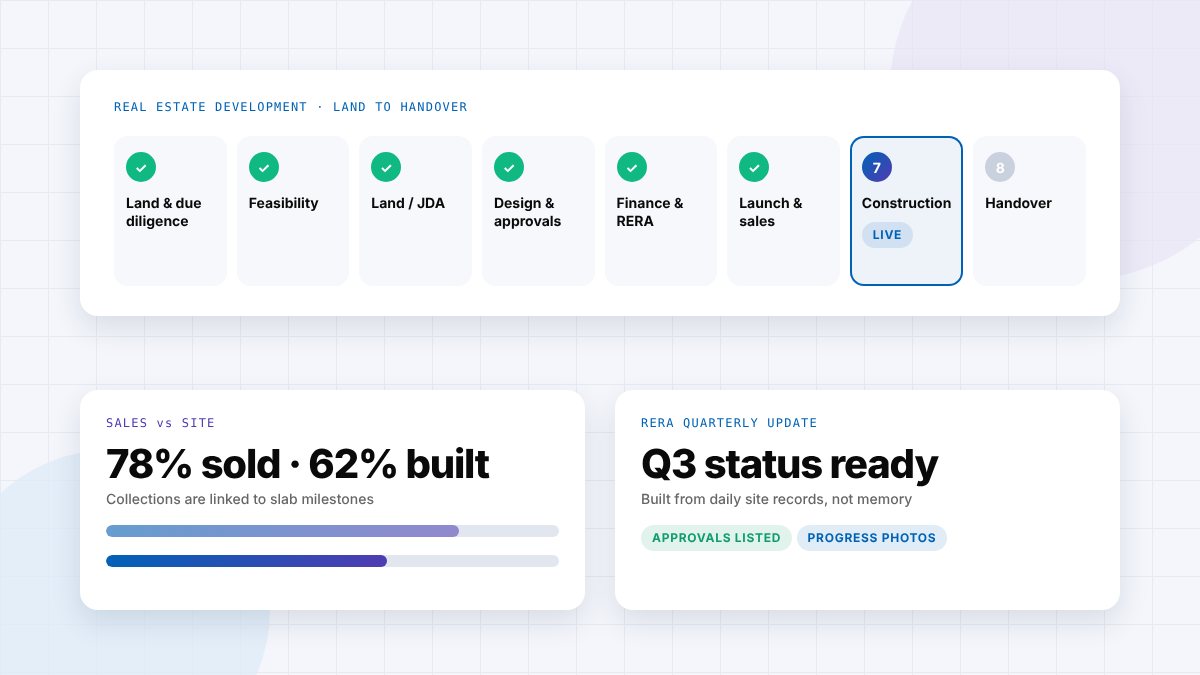
The short answer: The real estate development process runs from land to handover in eight stages: land identification and due diligence, feasibility, land acquisition or joint development, design and approvals, finance and RERA registration, launch and sales, construction, and completion and handover. Each stage has a gate (a decision, approval or document) that must be cleared before the next one, and most margin is won or lost in how tightly the developer controls the gap between sales commitments and construction reality.
A developer buys a 1.2-acre plot on the city's edge, launches 180 apartments eighteen months later, and promises possession in thirty-six months. By month thirty, the sales team has collected most of the money, the site is six months behind, steel prices have risen and buyers are calling every week. None of this started on site. It started at feasibility, approvals and launch, when decisions were made without a clear view of how construction would actually run.
This guide walks through the full real estate development process, stage by stage, with the key decisions, documents and risks at each one. It is written for developers in India, with notes for the UAE, Singapore and Sri Lanka.
The 8 stages of real estate development at a glance
| # | Stage | Key output | Gate to move on |
|---|---|---|---|
| 1 | Land identification and due diligence | Title, zoning and site report | Clean title and buildable land |
| 2 | Feasibility | Product mix, cost, revenue and cash-flow model | Board / investor approval |
| 3 | Land acquisition or joint development | Sale deed or joint development agreement | Land rights secured |
| 4 | Design and approvals | Sanctioned plans and statutory approvals | Building permit |
| 5 | Finance and RERA registration | Funding tie-up, RERA registration | Registration number before marketing |
| 6 | Launch and sales | Price list, bookings, agreements for sale | Target bookings reached |
| 7 | Construction | Structure, finishes, services | Completion and statutory inspections |
| 8 | Completion, possession and handover | Completion / occupancy certificate, possession, handover to association | Defect liability period closes |
Stage 1: Land identification and due diligence
Every project is limited by its land: what can legally be built on it, how much, and how cleanly the title can be transferred. Due diligence typically covers:
- Title: a title search going back over the ownership chain, encumbrance certificate, mutation records, and any litigation or claims.
- Zoning and land use: whether residential or commercial development is permitted under the master plan.
- Development potential: FSI or FAR, setbacks, height limits, road width and access.
- Physical site: soil, water table, drainage, flooding history, existing structures and utilities.
- Approvals history: any earlier sanctions, conversions or pending applications.
Problems found here are cheap to walk away from. Problems found after launch are not.
Stage 2: Feasibility study
A feasibility study answers one question: if we build this product on this land, at this cost and this price, does it make money with acceptable risk? It covers:
- Market: demand, competing projects, absorption rates and achievable prices.
- Product: unit mix, sizes, amenities and specification.
- Cost: land, approvals, construction, finance, marketing and overheads, with contingency.
- Revenue and cash flow: sales velocity, payment plan, and when money comes in versus when it goes out.
- Returns and sensitivity: what happens if sales are slower, costs rise or the project runs late.
Stage 3: Land acquisition or joint development
Developers secure land in two main ways:
| Outright purchase | Joint development agreement (JDA) | |
|---|---|---|
| How it works | Developer buys the land | Landowner contributes land; developer builds; built area or revenue is shared |
| Upfront capital | High | Lower, often with a refundable deposit |
| Control | Full | Shared decisions and obligations to the landowner |
| Key risk | Capital locked in land | Disputes over share, timelines and specifications |
Under a JDA, construction delays affect the landowner as well as buyers, so progress records and clear communication with the landowner matter from the start.
Stage 4: Design and approvals
Design develops from concept to working drawings, while the project moves through statutory approvals. In India these usually include building plan sanction from the local authority, plus approvals or NOCs that can include fire, environment (for larger projects), airport height clearance, utilities and others depending on size and location. In Chennai, plans go through CMDA or the local body under the Tamil Nadu building rules; in Bengaluru, through the city corporation under the Greater Bengaluru Authority.
Two things save time later:
- Freeze the design before tendering. Late design changes are among the most common causes of cost overruns and delays.
- Control drawings from the first issue. A drawing register and revision control prevent the site building from superseded plans. See our document control guide.
Stage 5: Finance and RERA registration
Projects are typically funded through a mix of equity, construction finance and customer collections. In India, the Real Estate (Regulation and Development) Act, 2016 shapes this stage:
- Registration before marketing: projects above the thresholds in the Act (land over 500 square metres or more than eight apartments, subject to state rules) must be registered with the state RERA authority before they are advertised, marketed or sold.
- Separate project account: 70% of amounts collected from buyers must be kept in a separate account and used only for land and construction costs of that project.
- Quarterly updates: the promoter must update the project's RERA page quarterly with bookings, approvals and construction status.
- Possession date: the date declared at registration becomes a commitment, with consequences for delay.
In the UAE, off-plan sales are regulated through escrow arrangements; in Singapore, developers are licensed and sale procedures are prescribed. Check the rules in each market; our market guide summarises them.
Stage 6: Launch and sales
Launch converts the feasibility plan into cash. Pricing, payment plans and the sales pipeline all depend on construction:
- Construction-linked payment plans tie collections to milestones such as foundation, each slab and finishing. If the site slips, collections slip too.
- Buyer communication needs regular, evidence-backed progress updates, which come easily when daily site records exist.
- Sales promises about specifications, amenities and dates must match what construction can deliver.
Stage 7: Construction
Construction is the longest stage and where most of the project's money is spent. For the developer, the job is not to build but to keep control: of progress, quality, cost, safety and information. The key controls are:
- A realistic master schedule and weekly look-ahead (scheduling guide).
- Daily progress reports with quantities, labour, materials and delays (DPR guide).
- Cost control linking budget, commitments and site events (cost control guide).
- Material management from indent to consumption (material management guide).
- Quality and safety with inspection plans and hold points (safety and quality guide).
- Contractor management for every package (contractor and subcontractor guide).
The biggest risk in this stage is the gap between the developer's office and the site. Decisions are made on information that is days old, and problems surface only when a milestone is missed.
Stage 8: Completion, possession and handover
- Completion and statutory inspections: fire, lift, utilities and other final approvals.
- Completion or occupancy certificate from the competent authority, confirming the building can be occupied.
- Snagging and pre-handover inspections of each unit and the common areas.
- Possession to buyers with documents, manuals and warranties.
- Handover to the residents' association, including common areas, records and maintenance arrangements, as required under RERA and state law.
- Defect liability period: under RERA, the promoter must fix structural and workmanship defects reported within five years of possession.
Good records from the construction stage (as-built drawings, test certificates and inspection records) make this stage faster and protect the developer during the defect liability period.
Where developers lose margin
- Optimistic feasibility timelines that drive interest and overhead costs up.
- Late design changes after construction has started.
- Approval delays not built into the plan.
- Sales promises that construction can't keep.
- Weak site control: material wastage, unchecked labour bills and rework.
- Slow information: problems found weeks after they started.
Where software and AI fit
Developers increasingly run several projects at once, often with a small head office. The constraint is not the number of people but how quickly accurate information reaches them.
Brikito is AI construction management software built for developers and their site teams. Site chat, attendance, material indents, drawings and daily reports live in one app, and Brik AI answers questions such as "which projects are behind plan?" from live data across all sites. Approvals stay with the PM, and the developer's office sees the same picture as the site without driving there. See how it compares in our guide to the best AI construction management software.
Real estate development checklist
- Has title and zoning due diligence been completed and documented?
- Does the feasibility model use a realistic construction timeline and contingency?
- Are land rights secured, and are JDA obligations clear?
- Is the design frozen before tendering, and are drawings under revision control?
- Is the project registered with RERA before any marketing?
- Do payment plans and sales promises match the construction schedule?
- Does the office see daily progress, cost and quality from every site?
- Is the handover file being built during construction?
Frequently asked questions
What are the stages of real estate development?
The main stages are land identification and due diligence, feasibility, land acquisition or joint development, design and approvals, finance and RERA registration, launch and sales, construction, and completion, possession and handover.
How long does a real estate development project take in India?
It varies with size, location and approvals. A mid-size residential project often takes several years from land to handover, with approvals alone taking months. Build realistic durations for approvals and construction into the feasibility model.
When must a project be registered under RERA?
Under the RERA Act, 2016, projects above the thresholds set in the Act (land over 500 square metres or more than eight apartments, subject to state rules) must be registered with the state RERA authority before they are advertised, marketed or sold.
What is a joint development agreement (JDA)?
A JDA is an arrangement where a landowner contributes land and a developer builds the project, with the built area or revenue shared between them on agreed terms.
What is the difference between an occupancy certificate and a completion certificate?
Terminology varies by state. Generally, a completion certificate confirms the building was built according to the sanctioned plan, and an occupancy certificate confirms it is fit to be occupied. Buyers should check that the relevant certificate has been issued before taking possession.
How can developers monitor multiple construction projects at once?
Agree a standard set of daily updates for every site, capture them where the work happens, and give the office a live, multi-project dashboard. AI construction management software such as Brikito turns site chat, attendance and indents into that view automatically.
Control the gaps between stages
Real estate development succeeds or fails at the joins: between land and design, design and approvals, sales and construction, and above all between the office and the site. Treat every stage as a gate, plan with realistic timelines, and make sure the information from site reaches the people making decisions while there is still time to act.